
Reading
Reading
READING. Can you play the piano?

Mark: What’s your favourite pastime, Tom?
Tom: I like playing the piano.
Mark: Can you play the piano?
Tom: Yes, and I can play the guitar too.
Mark: Oh! I’m surprised. I can’t play any instrument!
Tom: And what can you do?
Mark: I can swim. I love swimming.
Tom: Do you swim everyday?
Mark: Only at weekends.
Tom: Where do you swim?
Mark: I go to a club, near my house.
Language Focus
| What’s your favourite pastime? | ¿Cuál es tu pasatiempo favorito? |
| I like | Me gusta. Recordemos que esta expresión va seguida de un sustantivo o de un verbo en -ing |
| Can you play the piano? | ¿Sabes tocar el piano? |
| I can play the guitar | Sé tocar la guitarra |
| too | también |
| I’m surprised | Estoy sorprendido |
| I can’t play any instrument | No soy capaz de tocar ningún instrumento |
| What can you do? | ¿Qué sabes hacer? |
| I can swim | Sé nadar |
| I love | Me encanta. Recordemos que esta expresión va seguida de un sustantivo o de un verbo en -ing |
| only | solamente |
| at weekends | los fines de semana. Notar el uso de la preposición at |
| where | dónde |
| near | cerca de |
Comprehension Questions. Answer the following questions about the text.
1. What is Tom’s favourite pastime?
2. Can Mark play the guitar?
3. What does Mark like doing?
4. How often does he swim?
5. Where does he go swimming?
NEW WORDS AND EXPRESSIONS. Abilities – Habilidades
Can you type?
¿Sabes escribir a máquina?
Yes, I can.
Sí, sé.
No, I can’t. / No, I cannot.
No, no sé.
Can you speak Chinese?
¿Sabes hablar chino?
Can you play the guitar?
¿Sabes tocar la guitarra?
She can drive.
Sabe conducir.
She can’t drive.
No sabe conducir.
He can cook.
Sabe cocinar.
He can’t cook.
No sabe cocinar.
What languages can you speak?
¿Qué idiomas sabes hablar?
What can you do?
¿Qué sabes hacer?
Es importante notar que en este caso se utiliza “can” para hablar de habilidades. Equivale al español “saber”.
El auxiliar “can” tiene también puede significar “poder”. En dicho caso, no especifica una habilidad sino una posibilidad, como se explica más adelante en esta misma lección.
GRAMMAR. Uso del auxiliar can
En lecciones anteriores ya hemos estudiado el auxiliar DO. Ahora es el turno de CAN. Este auxiliar tiene dos usos principales:
1. Para expresar una habilidad. Es el equivalente al español “saber”.
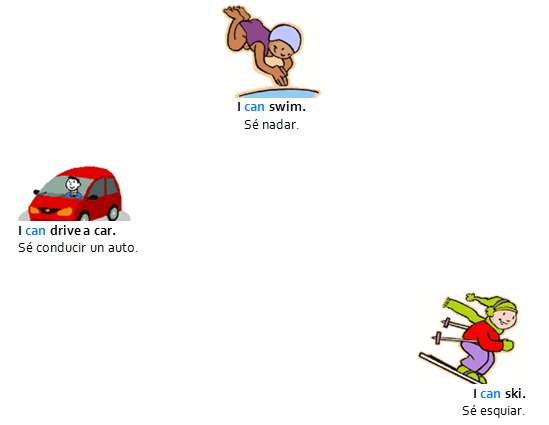
2. Para expresar una posibilidad. Es el equivalente al español “poder”.
Can I go home?
¿Puedo irme a mi casa?
Where can I buy some apples?
¿Donde puedo comprar unas manzanas?
When can you come?
¿Cuando puedes venir?
How can I go to the airport?
¿Cómo puedo ir al aeropuerto?
El auxiliar CAN es igual para todas las personas.
|
CAN PLAY |
||
|
I |
can |
play |
|
You |
can |
play |
|
He |
can |
play |
|
She |
can |
play |
|
It |
can |
play |
|
We |
can |
play |
|
You |
can |
play |
|
They |
can |
play |
GRAMMAR. Uso del auxiliar can
La forma interrogativa se construye colocando primero el auxiliar can, luego la persona y después el verbo base.
|
CAN PLAY |
||
|
Can |
I |
play? |
|
Can |
you |
play? |
|
Can |
he |
play? |
|
Can |
she |
play? |
|
Can |
it |
play? |
|
Can |
we |
play? |
|
Can |
you |
play? |
|
Can |
they |
play? |
La forma negativa se construye agregando NOT luego de can. Puede usarse también la forma contracta can’t.
|
CANNOT PLAY |
||
|
I |
can’t / cannot |
play |
|
You |
can’t / cannot |
play |
|
He |
can’t / cannot |
play |
|
She |
can’t / cannot |
play |
|
It |
can’t / cannot |
play |
|
We |
can’t / cannot |
play |
|
You |
can’t / cannot |
play |
|
They |
can’t / cannot |
play |
Para responder a una pregunta formulada con can, se usa Yes / No, seguido de la persona y luego, el auxiliar can si la respuesta es afirmativa o can’t / cannot si es negativa.
Can you play the piano?
Yes, I can.

Can you play the piano?
No, I can’t. / No, I cannot.
But I can play the guitar.
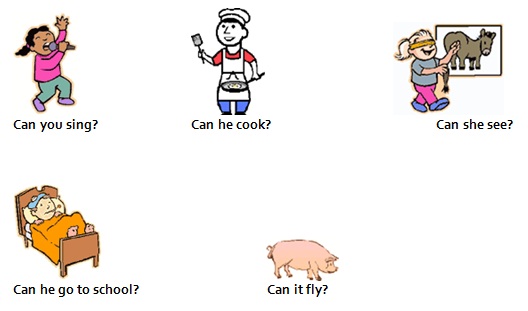
¡Ahora ponte a prueba!
Piensa cómo responderías a estas preguntas.
Para ver la respuesta, pasa el mouse sobre cada imagen.
EXERCISES
En esta parte podrás aplicar lo aprendido, practicar y comprobar que recuerdas tanto el vocabulario como la gramática de la lección. Completa con can o can’t.
1. Where I see a good rock concert?
2. Can Lisa speak French?
No, she .
3. What you do?
4. Can Lucy drive?
Yes, she .
5. Where I buy a new camera?
6. you read in Portuguese?
Yes, I can.
7. Can I invite my friends?
Yes, they come.
8. you help me, please?
9. you play the piano?
10. I find my keys. Where are they?
2) Reescribe las siguientes oraciones en su forma negativa. Usa las formas cortas de los verbos siempre que sea posible.
1. I can drive.
2. Lisa is very intelligent.
3. You can go.
4. I’m having dinner.
5. Thomas is wearing a hat.
6. That tie matches your trousers.
7. This sweater suits you.
8. They can stay here.
9. It is very cold here.
3) Elige la opción más adecuada para responder a las siguientes preguntas.
Can you drive?
Yes, I do.
Yes, I can.
Can I go now?
Yes, you can.
Yes, you are.
Can this computer do my homework?
No, you can’t.
No, it can’t.
Can I help you?
Yes, please.
Yes, I can.
Can you help me?
Yes, you are.
Yes, I can.
Can I go to the toilette?
No, you can’t.
Yes, I can.
Can Sheila stay at home?
Yes, she does.
Yes, she can.
Can I go to the cinema?
No, you can’t.
No, you don’t.